
The Gap and the Gain: How Christian Couples Should Measure Financial Progress
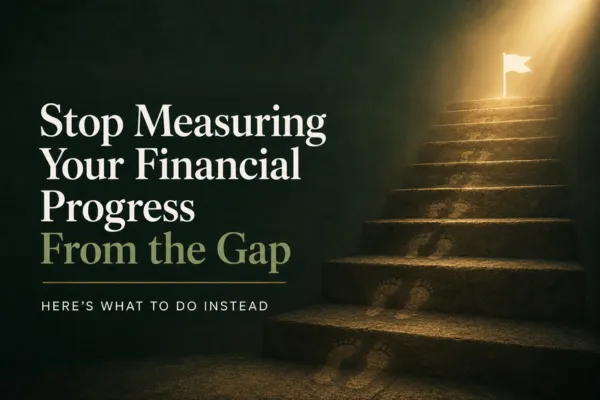
Stop Measuring Your Financial Progress From the Gap - Here’s What to Do Instead
High achievers who measure financial progress from the Gap - always looking at how far they still have to go - experience chronic dissatisfaction. Here’s the Biblical and research-backed alternative.
Most couples measure their financial progress by looking forward - at how far they still have to go. The debt not yet paid, the savings account not yet full, the income not yet at the level they’ve imagined. And the more faithfully they pursue financial goals, the more they feel like they’re constantly falling short.
Dan Sullivan and Dr. Ben Hardy identified this pattern in their research on high achievers and named it living in the Gap. And it turns out the measurement itself is the problem.
What Living in the Gap Does to You
The Gap measurement compares your current reality to your ideal future. The problem is structural: the ideal keeps moving. Every time you reach a new level, a new level appears on the horizon. By this measurement, you can never actually arrive - no matter how far you’ve come.
Sullivan and Hardy found that many high-achieving people - the ones you’d most expect to feel successful - walk around feeling chronically behind. Not because they haven’t accomplished much, but because of how they’re measuring.
You cannot measure growth by looking forward at where you have not yet arrived. You measure growth by looking backward at where you used to be.
The Alternative: Living in the Gain
The Gain measures in the opposite direction - from your starting point to where you currently are. The distance you’ve already traveled, not the distance still remaining. This single shift is the difference between chronic dissatisfaction and genuine, well-earned confidence. And it’s backed by scripture.
Being confident of this, that he who began a good work in you will carry it on to completion.
— Philippians 1:6
This confidence is rooted in looking backward - at the good work God has already begun - not in anxiously calculating the distance still remaining. Confidence, in this verse, is a Gain measurement applied to your entire life.
What This Looked Like for Our Family
In 2015 JP and I sold our house and moved into my parents’ basement. Gap measurement: two college-educated adults in their 30s, living with my parents. Only failure.
But here’s what the Gain measurement showed: at that closing table, we received a check for more money than I’d made in an entire year of teaching. We had turned a purchase into a profitable sale. That was a real financial skill we’d never had before. Real progress.
The Gap said: you just lost your house. The Gain said: you just proved you can make money in real estate. Which measurement gave us the confidence to buy the next property? The Gain, every time.
What Matt Said That Said Everything
One of the couples in our coaching program described what shifted after working through this framework: “Getting out of small pond thinking has rocked my world.” Small pond thinking is Gap thinking - measuring your capability by the ocean you haven’t yet reached instead of by how far you’ve already swum from shore. When Matt stopped measuring from the Gap and started measuring from the Gain, the mindset shifted. And the results followed.
How to Apply This Right Now
Look backward. Not at where you want to be - at where you were five years ago. What has changed? What have you learned? What did you overcome? That distance is your proof. Not proof of perfection. Proof of growth, resilience, and capability you’ve been undervaluing because you’ve been measuring in the wrong direction.